
Common Reasons Packers and Movers Claim Get Rejected (2026 Guide)
Shifting reimbursement is a valuable benefit offered by many private companies, multinational corporations, and government departments. Despite their benefits, a large number of shifting claims are rejected each year due to avoidable documentation errors.
💡 Quick Answer: Relocation claims are rejected due to incomplete billing format, missing GST breakup, incorrect amounts, address mismatches, late submission, and duplicate claim submissions. A GST-compliant invoice and a timely claim submission prevent most rejections.
You might think only a packers and movers bill is enough to claim relocation reimbursement, but there is more to it. The organisations deeply examine everything related to your relocation, including the authenticity of the moving company, GST compliance, address accuracy, invoice structure, payment proof, and company policy limits.
If you have just shifted and are moving forward with submitting your reimbursement claims, or you have already submitted them and received a rejection, we are here to help. This complete guide explains the most common reasons reimbursement claims are rejected and how to prevent costly mistakes.
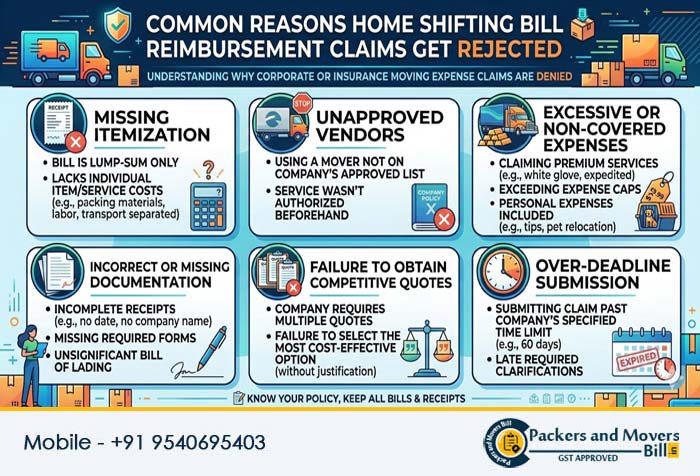 Understand key factors leads relocation reimbursement denial
Why do companies strictly verify your shifting claims?
A shifting reimbursement involves financial payouts. That is why organisations conduct strict expense audits to detect fraudulent claims and enforce policy limits. However, a minor formatting error may lead to claim rejection. Here are the common reasons for relocation claim rejection.
1- Incorrect or incomplete invoice format
The number one reason claims are rejected is an incorrect or incomplete invoice format. A valid and reimbursement-ready packers and movers bill must mention these points:
a- Invoice number
b- Date of service
c- Full pickup address
d- Full delivery address
e- Service description
f- Taxable amount
g- GST percentage
h- Total payable amount
If your bill misses any of these points, HR will immediately reject your claim.
2- Missing GST breakdown
Many companies require a GST-compliant bill for reimbursement. There are common GST-related errors that you may overlook, such as:
a- GST percentage not mentioned
b- You haven't separated the tax amount from the base amount
c- The bill mentions incorrect tax calculation
d- No clear taxable value mentioned
e- The total amount gets mismatched
GST mistakes are the number one reason for your claim to be rejected in the fastest possible way. So make sure to double-check Base amount + GST = Final total.
If you want to know more about GST charges on packing and moving then, you can explore our expert guide on GST applicable for relocation services.
3- You submit the estimate instead of the final invoice
One of the most common mistakes an employee makes is submitting the estimate from packers and movers instead of the final bill. The estimate includes:
a- Booking confirmation
b- Estimated amount
c- Quotation copy
d- Shifting date
These sets are not eligible for reimbursement. Only the final GST invoice can be accepted in most organisations.
4- Amount mismatch or missing payment proof
Before approving your shifting allowance, the HR department asks you to submit the following:
a- Bank statement
b- UPI transaction
c- Cash memo if paid in cash
d- Company payment receipt
Suppose the invoice shows the final payable amount is ₹35,000, but the payment proof you provided to HR shows ₹30,000; this would lead to a claim refusal. Most organizations only accept online payments, not cash.
5- Incorrect relocation dates
Another reason your company declines relocation allowance is due to a date mismatch:
a- Invoice states a different date from the shifting date
b- Pickup and delivery dates are not aligned
c- Your relocation date doesn't match the transfer letter
Always ensure that the invoice date, transfer order date, and claim submission date are all aligned as per company guidelines.
6- Incomplete source or destination address
Always make sure that the documents clearly mention:
a- House number
b- Area name
c- City
d- State
e– Pin code
In some cases, employees try to relocate from their hometown rather than to their job location, which is not acceptable.
7- You submit the claim after the deadline
To claim the reimbursement, you must meet the deadlines. The most common timeline for private and government companies to approve shifting expenses is 30 to 90 days.
Late submission of a claim may result in automatic rejection. So make sure to avoid this situation, confirm the HR deadline, and the required approval timeline.
8- Exceeding company reimbursement limits
Some organisations often define:
a- Maximum limit for local shifting
b- Maximum limit for intercity relocation
c- Separate limit for vehicle transport
If your invoice exceeds the limit, then your reimbursement may be partially approved or rejected.
That is why it is important to check the allowed reimbursement cap before you submit the claim.
9- Missing supporting documents
Submitting just an invoice is not enough; you also need to submit other supporting documents. Here is the list of supporting documents:
a- Transfer letter
b- HR approval email
c- Joining letter
d- Payment proof
e- Relocation approval document
Missing supporting documents is a common reason for rejection. So make sure always to attach your supporting documents to the claim submission.
10- Duplicate or suspicious bill details
The next reason your claim submission may fail is that you submit a duplicate or suspicious invoice. If HR notices these points, then it will lead to rejection:
a- Repeated invoice number
b- Unclear formatting
c- Suspicious GST entries
d- Inconsistent service description
The HR department can flag the claim for verification. That's why clarity and consistency are most important for this process.
11- Submitting handwritten or unclear invoice copies
The next point that can mess with your reimbursement process is submitting a handwritten or unclear invoice. Some employees submit:
a- Blurred photos
b- Handwritten bills
c- Cropped screenshot
d- Partial invoice pages
These types of documents are never accepted
Make sure to submit
a- Clear PDF
b- Complete invoice with seal and authorized signature
c- Properly formatted documents
12- Incorrect service description
The shifting bill should clearly mention the type of relocation that you did, such as:
a- Household relocation
b- Office shifting
c- Car transportation
d- Packing and loading services.
When you use vague descriptions, it can create hurdles or even lead to rejection of your claim.
13- Multiple claims for the same shifting
One common mistake employees make is submitting multiple claims for the same move. If you are also:
a- Duplicate claim
b- Multiple invoice copies
c- Separate vehicle + household claim without clarification
It is going to take you a review or rejection from HR. Make sure to be clear in your claim submission.
How can you avoid a shifting claim rejection?
If you have gone through claim rejection or don't want to face this situation, then make sure to follow these points before you proceed with the claim:
- Reverify the invoice format
- Check GST breakup
- Confirm pickup and drop-off addresses are correct
- Does your quoted amount match the payment proof?
- Check relocation date
- Review reimbursement limit
- Attach all required documents
- Make sure to submit the claim within the deadline
If you take just 10 minutes to review these details before you submit the claim, the rejection rate decreased by 90% and you can avoid weeks of delay.
What to do if your claim is declined?
If you have already submitted your claim and HR or your company has turned down your claim, then here are some of the points that you can follow:
1- Ask HR to provide you with a written rejection reason
2- Check for documentation gap
3- Check for proper bill structure
4- Reattach missing documents
5- Resubmit properly.
Most of the rejections are flexible.
City-based structured invoice support
If you have moved to a major metro city, you can avail of structured invoice assistance.
For example, if you have done shifting in Bangalore, then you can explore GST Shifting Invoice Support in Bangalore.
If your relocation was within Hyderabad, you can check the Relocation Reimbursement Bill for Hyderabad.
Final words
It is very rare for a claim to be rejected, but if you are facing one, it may be primarily due to documentation errors, not because your relocation was invalid.
When you ensure a properly structured invoice, GST compliance, consistent payment proof, and timely submission, then it can increase the approval chances.
That is why it is important to review the documentation before submission carefully and to maintain digital copies for future reference.
Frequently Asked Questions
Frequently Asked Questions About Common Reasons Shifting Claims Get Rejected
-
Q1. Why did my relocation reimbursement claim get denied?
The primary reason for getting bill claim rejection is due to incomplete bill format, missing GST breakup, incorrect amount, address mismatch, or late submission.
-
Q2. Can I resubmit a rejected shifting claim?
Yes, once you have corrected the documentation error, you can do it. Most of the companies allow resubmission of shifting claims.
-
Q3. Is GST mandatory for relocation reimbursement?
Your company might ask for a GST breakdown, but policies can be different from company to company.
-
Q4. What documents are required for relocation reimbursement?
Ideally, the bill, payment proof, transfer letter, and HR approval are required for reimbursement.
-
Q5. Can I claim relocation without the original invoice?
Some of the employers accept structured duplicate invoices as per their policies.
Our Blog
Verify the GSTIN of any Moving Company in 5 Min.
Before hiring any movers first you need to verify the genuinity of that service provider. Here how you...
Why HR Rejects Your Relocation Claims
Check why HR or finance department declines the relocation claims. What mistakes you can avoid to...
Learn How to Reduce Home Shifting Cost
You can make your move affordable if you use some simple cost reduction strategies. Check this article to know...
 Generate GST Invoice Now